Transportation upgrades are easy to sell because the base option is described first and the appealing photographs appear second. The sensible response is not to reject every upgrade. It is to identify what changes, decide whether that change matters for a journey of roughly three hours, and compare the price for the entire party.
FRS Clipper divides seating on the Victoria Clipper V into three broad classes: Economy on the lower deck, Vista on the upper deck, and Comfort in a private upper-deck cabin. Each has sub-options such as standard, panoramic, or VIP seating. The names suggest a hierarchy, but the best seat is not automatically the most expensive one.
This guide uses the company’s current published seating and vessel descriptions. Seat maps, availability, amenities, and upgrade prices can change, so review the live booking details for your sailing.
Start With the Length of the Trip
The Seattle–Victoria crossing is long enough for seat comfort to matter and short enough that a restrained choice is usually fine. You are not buying a lie-flat overnight flight. You are selecting where to spend part of a morning or afternoon while the same vessel carries everyone to the same terminal.
For a solo traveler, a modest upgrade may be easy to justify. For a family of four, the identical per-seat premium becomes a material part of the weekend budget. Always multiply the upgrade by the passenger count before deciding. Then ask what else that money could buy: a better hotel location, museum tickets, a meal, or an extra night.
The sailing itself matters too. A daylight crossing with a promising forecast creates more value for panoramic seating. An evening trip in poor visibility makes the view less important. No class can guarantee calm water, wildlife sightings, or perfect weather.
Economy: The Practical Default
Economy occupies the lower deck and is the right starting point for most price-conscious travelers. It provides assigned transportation without asking you to pay for a bundle of extras you may not use. If your plan is to read, talk, listen to a podcast, or simply reach Victoria, Economy can do the job.
Within Economy, the distinction between standard and panoramic seating is mainly about position and view. A window does not always deliver an uninterrupted postcard scene; reflections, neighboring passengers, spray, and weather all affect the experience. Travelers who care strongly about the view should confirm the seat map rather than assume any window-adjacent label is equivalent.
Economy is especially sensible for groups, repeat passengers, and people who expect to move around when permitted. It is also a good choice when the upgrade price has surged on a busy date. The downside is a busier cabin environment and fewer included comforts. Bring the small items that make shared transport pleasant: a layer, headphones, water where allowed, and a downloaded book or show.
Vista: Paying for the Upper Deck
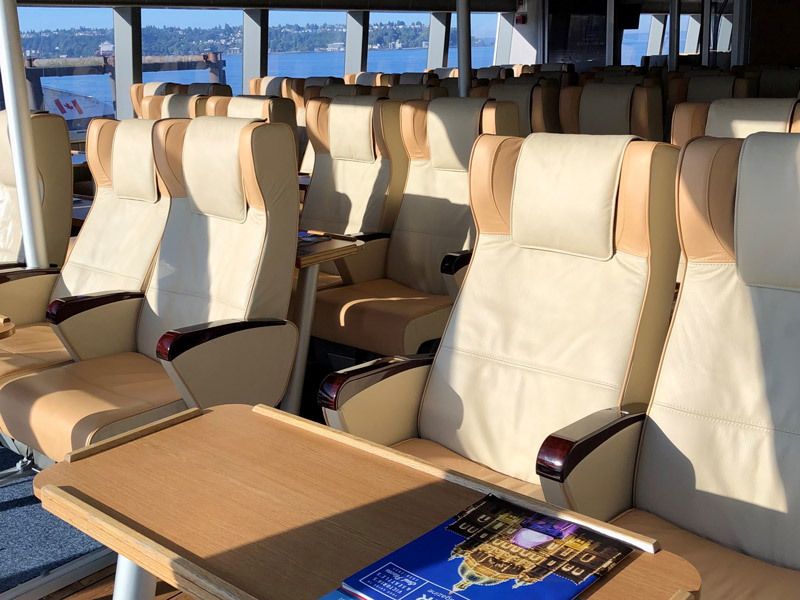
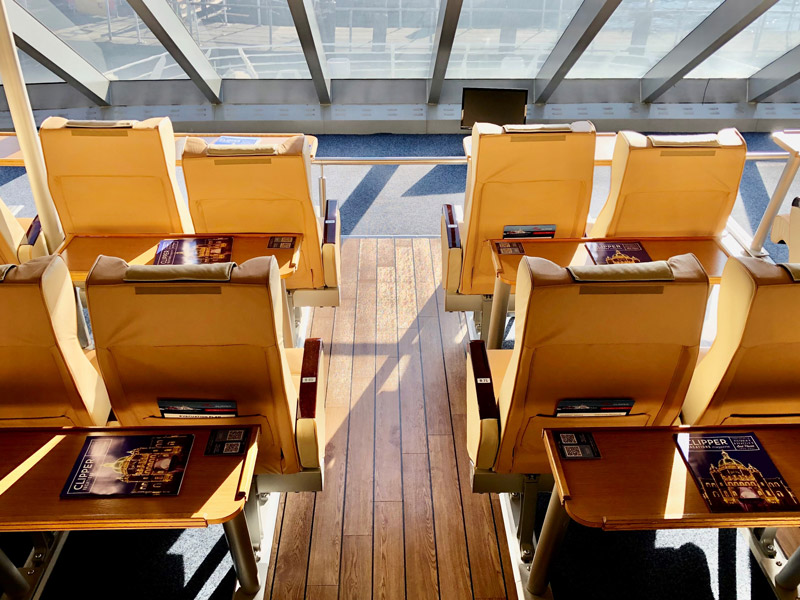
Vista is the middle option. FRS Clipper describes its upper-deck section as having spacious leather seats, panoramic views, and table seating for small groups. It appeals to travelers who want the trip to feel more scenic without paying for the full Comfort package.
The most defensible reason to choose Vista is the upper-deck environment. If looking out across the Salish Sea is part of why you selected the ferry, better sight lines can make the crossing more memorable. A table can also be useful for a small group that wants to talk, play a game, or organize plans.
Vista is less compelling when you plan to sleep, work with headphones, or travel after dark. It may also be a questionable value if only scattered seats remain and the group cannot sit together. Check the actual seat-selection screen before treating the class name as a guarantee of the experience you want.
Some motion-sensitive passengers assume an upper deck will be better because the view helps orient the body. Others prefer being lower and nearer the vessel’s center of motion. There is no universal rule that replaces personal experience. If seasickness is a concern, seat location is only one part of preparation.
Comfort: A Quieter, More Inclusive Bundle
Comfort Class is located in a private upper-deck cabin. FRS Clipper currently lists leather seating, panoramic views, and complimentary snacks, coffee, and tea among its benefits. Comfort VIP is positioned as the highest seat option within that cabin.
The value is not the retail price of coffee and snacks. It is the combined effect of a more separated cabin, upgraded seating, and fewer small purchases to think about. Travelers celebrating an occasion, people who need a calmer environment, or anyone who wants the crossing to feel like part of the holiday may find the bundle worthwhile.
Comfort can also be useful for business travelers who need to arrive composed, though no shared passenger cabin should be treated as a confidential office. Internet access and mobile coverage should never be assumed for critical work. Download files before boarding and plan for interruptions.
The mistake is buying Comfort solely because “complimentary” sounds valuable. If you would be happy in Economy and spend only a few dollars onboard, the arithmetic may not favor the upgrade. Price the experience, not the snacks.
What VIP Should Mean to You
The VIP label can create expectations that exceed what a ferry seat can deliver. Evaluate Comfort VIP by the concrete seat location, spacing, and included amenities shown during booking. Do not translate the name into airport-lounge service, priority border processing, or a private room unless the booking terms explicitly say so.
For some travelers, the best-positioned seats are worth securing. For others, the VIP premium is the easiest cost to cut. If the seat map shows an arrangement that matters to you—such as a preferred view or separation from traffic—then the upgrade has a clear purpose. If the only reason is the label, pause.
Families, Couples, and Solo Travelers
Families should focus first on sitting together. A theoretical better view is not helpful if the available layout splits adults and children. Check how the booking system assigns seats and whether changes are allowed. Snacks and a quieter cabin may have more value with children, but the total premium rises quickly.
Couples may appreciate panoramic or Comfort seating because the crossing becomes part of a weekend away. Still, two Vista seats plus a planned meal in Victoria may be more memorable than two top-tier seats and a compromised dinner budget.
Solo travelers have the most flexible calculation. One upgrade affects only one fare, and a comfortable seat can make a noticeable difference. On the other hand, a solo passenger can often adapt more easily to available Economy seating and spend the savings at the destination.
Accessibility and Specific Needs
Do not rely on marketing photographs to answer accessibility questions. Contact FRS Clipper before booking if you use a wheelchair, have limited mobility, travel with a service animal, require medical equipment, or need help boarding. Ask about the entire journey: terminal access, ramps, elevators or stairs, accessible seating, restrooms, and arrival procedures.
Similarly, travelers with sensory needs should ask what “private cabin” means in practice and whether a particular sailing is expected to be busy. A paid class can improve the environment, but only direct information can establish whether it meets a specific need.
A Better Way to Decide
First, price Economy for the whole party. Second, price Vista and Comfort for the same sailing. Third, write down the exact differences you value. If you cannot name them, keep the base fare.
Choose Economy when transportation is the priority, the group is large, or the savings improve the destination. Choose Vista when scenery and upper-deck space are important. Choose Comfort when a quieter cabin and included refreshments meaningfully improve the trip. Consider VIP only when its precise seat advantages matter to you.
Review both outbound and return sailings independently. You might choose a panoramic seat in daylight and Economy after sunset. There is no rule that both directions need the same class.
The Tested Truth Verdict
FRS Clipper’s seating structure offers real differences, but none of them changes the core route. Economy is the honest default and likely the best value for many passengers. Vista is the most interesting middle ground for travelers who chose the ferry partly for the view. Comfort makes sense when cabin atmosphere, space, and a small bundle of amenities are worth paying for.
The right upgrade has a reason attached to it. Decide from the seat map, sailing time, weather expectations, group size, and total price—not from the prestige of the name. That approach leaves more of the travel budget available for the place you crossed the water to see.
Disclosure: This article contains an affiliate link. Tested Truth may earn a commission if you make a qualifying purchase, at no additional cost to you. Editorial judgments remain independent.